

.jpg?width=300&name=IngredientSpotlight-powders%20(1).jpg)
Adding powders into liquids sounds straightforward — until clumping, fisheyes, dusting, and long batch times start creeping in. Across chemical and hygienic processes alike, powder incorporation is often the most problematic step in the entire mixing operation.
In most cases, the formulation isn’t the issue. The real challenge lies in how powders are introduced and dispersed — and that’s where the right mixing technology makes all the difference.
Why Powder Addition Causes So Many Mixing Problems
When powders are added manually or dumped into an open tank, they tend to sit on the liquid surface, hydrate unevenly, and form agglomerates that are difficult to break apart later.
Common issues include:
- Fisheyes caused by rapid surface hydration
- Clumping and agglomeration from poor wet-out
- Dusting that creates safety and housekeeping concerns
- Extended batch times spent trying to correct poor dispersion
- Inconsistent results from operator-dependent powder addition
Once these problems form early in the batch, they often persist throughout the process.
Wet-Out Is the Real Challenge
Successful powder incorporation depends on rapid, uniform wet-out — the moment dry particles become fully surrounded by liquid. If this doesn’t happen immediately, partially hydrated shells can trap dry material inside, creating stubborn agglomerates.
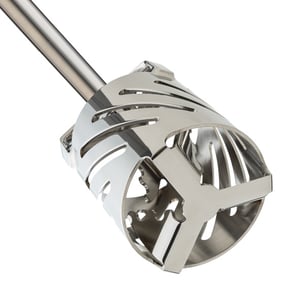 High shear mixers like the Rotosolver® are designed to address this exact challenge. By creating intense, localized shear zones inside the tank, the mixer actively pulls powders below the liquid surface and disperses them before agglomerates can form.
This controlled application of shear promotes:
- Faster wet-out
- Uniform hydration
- Reduced risk of fisheyes and clumps
The Advantage of Controlled Powder Induction
One of the most effective ways to eliminate dusting and improve consistency is controlled powder induction. Instead of adding powders manually, powder induction systems draw dry ingredients directly into the liquid stream.
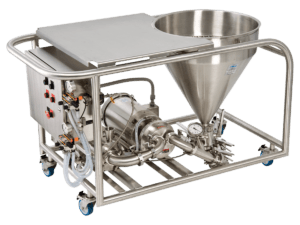 Solutions like Fastfeed® integrate powder induction with high shear mixing, allowing powders to be introduced in a closed, controlled manner. The result is:
- Minimal dusting and improved operator safety
- Faster incorporation and shorter batch times
- More consistent dispersion from batch to batch
- Less reliance on operator technique
By introducing powders directly into the high shear zone, the process becomes repeatable and far more forgiving.
High Shear Mixing vs. Low Shear Agitation
Low shear agitators are excellent for maintaining homogeneity, but they struggle when it comes to initial powder incorporation. They simply don’t generate enough energy to properly wet and disperse difficult powders.
High shear mixers — whether in-tank or inline — apply shear where it matters most:
- At the point of powder entry
- During early wet-out
- Before viscosity increases
For processes involving gums, thickeners, pigments, or fine powders, high shear mixing isn’t optional — it’s essential.
Inline Mixing for Continuous Powder Addition
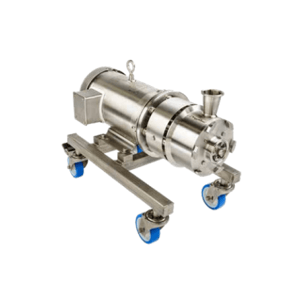 For continuous or recirculating processes, inline high shear mixers such as Dynashear® provide consistent dispersion and particle reduction as material moves through the system. When paired with controlled powder induction, inline mixers help maintain uniformity without interrupting production.
This approach is particularly effective for:
- High-throughput operations
- Processes requiring tight control over dispersion
- Applications where batch variability must be minimized
Designing a Cleaner, More Consistent Mixing Process
Improving powder-to-liquid mixing isn’t about adding more horsepower — it’s about applying shear at the right time and in the right place. When powder addition is engineered into the process using the proper mixer and induction method, the benefits are immediate:
- Shorter batches
- Cleaner production environments
- More consistent product quality
- Reduced operator dependency
Whether you’re producing coatings, agrochemicals, beverages, or specialty formulations, getting powder incorporation right sets the tone for the entire batch.
Final Thought
If clumping, dusting, or long mix times are slowing down your operation, the problem likely isn’t your ingredients — it’s how they’re being introduced. With high shear mixing and controlled powder induction technologies like Rotosolver®, Fastfeed®, and Dynashear®, powder addition becomes a controlled, repeatable part of the process instead of a persistent headache.