

HIGH SHEAR MIXER
High Shear Mixer Overview and Selection
High shear mixers are industrial mixers that generate intense, localized shear—typically in a rotor/stator zone—to accelerate wet-out, break down agglomerates, improve dispersion uniformity, and form stable emulsions. They’re most valuable when conventional tank mixers can’t consistently incorporate powders, eliminate clumps, or hit repeatable results at scale.
This guide helps you choose the right configuration based on your process: inline high shear mixing for controlled turnover in recirculation loops or continuous lines, and in-tank high shear mixing for flexible batch processing directly in the vessel. You’ll also find when to consider powder induction for cleaner powders-into-liquids addition, and when wet milling / inline milling is the better fit for tighter particle size requirements. Use the sections below to match your application and outcome to the right equipment path for chemical and hygienic manufacturing.
Choose Your High Shear Mixing Path
In-Tank High Shear Mixing
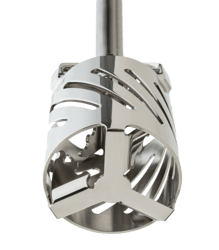
In-tank high shear mixing applies localized rotor/stator shear directly in the vessel to accelerate wet-out, reduce agglomerates, and support consistent batch results.

Inline High Shear Mixing
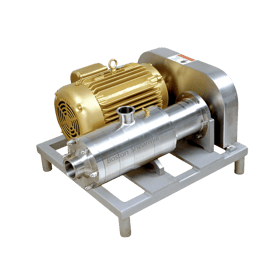
Inline high shear mixing processes material through a rotor/stator shear zone in a recirculation loop or continuous line for repeatable dispersion and emulsification.
Powders into liquids
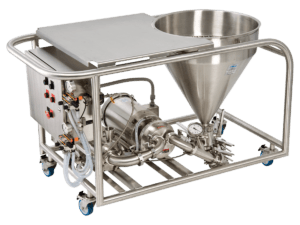
Powder induction supports controlled powders-into-liquids addition to improve wet-out and reduce clumping, often paired with high shear mixing for more consistent dispersion.
High Shear Mixer Topics and Process Guide
WHAT IS A HIGH SHEAR MIXER?
What “high shear” means in mixing
In mixing, “shear” describes the force created when adjacent layers of fluid move at different speeds. A high shear mixer is engineered to generate very high velocity gradients in a small zone—typically inside a rotor/stator head—so materials experience intense mechanical action as they pass through. The result is vigorous mixing where agglomerates are broken down, powders are wetted quickly, and droplets in an emulsion are reduced to a more uniform size. This is different from a standard impeller or tank mixer that mainly circulates material but may not generate enough localized shear to overcome clumping, poor wet-out, or inconsistent dispersion.
What problems it solves
High shear mixers are typically selected to solve problems that show up as quality variability or long processing times:
- Powders into liquids: rapid wet-out and hydration to minimize fish-eyes and floating clumps
- Dispersion: breaking down agglomerates for more uniform distribution of pigments, fillers, or functional additives
- Emulsions: creating and maintaining stable oil-in-water or water-in-oil emulsions through droplet size control
- Particle reduction: deagglomeration and size refinement, often as a precursor or alternative to milling
When a process requires consistency batch after batch—and downtime or rework is expensive—high shear mixing becomes a practical tool rather than a “nice to have.”
HOW HIGH SHEAR MIXING WORKS (ROTOR STATOR BASICS)
Rotor/stator shear zones
Most high shear mixers rely on a rotor/stator assembly. The rotor spins at high speed inside a stationary stator with precision openings. Product is drawn into the head, accelerated, and forced through small gaps and ports where shear is highest. This creates a controlled, repeatable environment for dispersion and emulsification—especially compared to open-tank vortex methods that can vary with operator technique, powder addition rate, and fluid level. The rotor/stator head is essentially a contained shear engine: material enters, experiences intense shear and turbulence, and exits with improved uniformity.
Tip speed vs shear rate (in plain terms)
Tip speed is the velocity at the outer edge of the rotor, and it’s a useful shorthand for “how energetic” the mixing head is. Shear rate is the speed difference across a small distance in the shear zone. Higher tip speeds and tighter clearances generally increase the shear rate, which improves wet-out, deagglomeration, and emulsification—up to the point where heat input, viscosity, or product sensitivity becomes a constraint. The practical takeaway is that high shear mixer selection is not just “fast is better.” It’s about achieving the required dispersion or emulsion quality with the right balance of shear energy, flow, and temperature control.
Why recirculation/flow matters
Shear doesn’t help if the material that needs work never passes through the shear zone. That’s why flow rate and recirculation are critical—especially in inline mixing. Good high shear mixing is a combination of: (1) the intensity of the shear zone and (2) how effectively the process moves all of the product through that zone. In many industrial systems, an inline mixer in a recirculation loop gives you predictable turnover and consistent results, while an in-tank high shear mixer can be ideal when you need direct vessel integration and batch flexibility. Either way, the goal is uniform exposure to shear across the entire batch or process stream.
TYPES OF HIGH SHEAR MIXERS
In-tank high shear mixer (when it wins)
In-tank high shear mixers mount directly on the vessel and apply shear within the batch. They’re often a strong fit when:
- you need maximum batch flexibility across products and viscosities
- vessel geometry and process constraints favor in-place mixing
- you want high shear capability without building an external recirculation loop
- you’re tackling challenging wet-out or dispersion steps early in the batch
In-tank high shear mixing can reduce processing time and improve consistency, especially when paired with the right tank mixers for bulk circulation and the right process sequence for ingredient addition.
Inline high shear mixer (when it wins)
An inline high shear mixer is installed in a pipe or loop so product is processed as it flows through the rotor/stator head. Inline mixers are often preferred when you need:
- consistent, repeatable processing through controlled turnover
- integration with powder induction or automated ingredient addition
- fast dispersion and emulsification with a compact footprint
- continuous processing or recirculation for higher throughput
Inline high shear mixing is especially effective for dispersion, emulsions, and powders into liquids because you can control flow, addition rates, and exposure time more precisely than in many open-tank methods.
HIGH SHEAR MIXER VS OTHER MIXING TECHNOLOGIES
People often search “high shear mixer” when they’re really trying to decide between technologies. Use this section to compare common options and clarify when high shear mixing is the right tool—and when a different approach fits the spec better.
High Shear Mixer vs High Speed Disperser
A high speed disperser (typically a saw-tooth blade) is often used for general dispersion and bulk turnover when powders wet out easily and the process can tolerate moderate variability. A high shear mixer uses a rotor/stator shear zone to generate intense, localized shear—often better for rapid wet-out, breaking down stubborn agglomerates, and forming stable emulsions. If your batch is sensitive to clumping, needs repeatable dispersion quality, or requires controlled emulsification, high shear mixing is usually the more reliable approach. If the goal is mainly blending and moderate dispersion, a high speed disperser may be sufficient.
High Shear Mixer vs Homogenizer
A high shear mixer is often used to create emulsions and improve uniformity through rotor/stator shear and controlled turnover. A homogenizer (commonly high-pressure) is typically chosen when the requirement demands tighter droplet size control, finer distributions, or very stable emulsions that exceed what rotor/stator shear alone can consistently deliver. In many processes, high shear mixing is used upstream to form a pre-emulsion and reduce large droplets, then homogenization is used downstream if the specification requires a more aggressive refinement step. The “right” choice depends on the target droplet size, stability expectations, and process constraints.
High Shear Mixer vs Shear Pump
A shear pump is often selected when you need pumping plus some shear, especially in recirculation loops. It can improve turnover and provide mixing energy, but it may not deliver the same intensity or controlled shear environment as a dedicated rotor/stator high shear mixer designed primarily for dispersion/emulsification. If your process goal is “move product and improve uniformity,” a shear pump may fit; if your process goal is rapid wet-out, deagglomeration, or strong emulsification performance, a high shear mixer is generally the better fit.
High Shear Mixer vs Colloid Mill / Wet Mill (Inline Milling)
High shear mixing can break down agglomerates and improve effective particle size by deagglomeration, but milling is typically chosen when you need true particle reduction to finer sizes or tighter distributions. A colloid mill or wet mill applies more aggressive mechanical action (often tighter gaps and/or grinding mechanics) to reduce particle size beyond what a standard rotor/stator mixer is designed to achieve. In many chemical processes (pigments, coatings, inks, resin systems), high shear mixing is used as a pre-dispersion step to wet out and stabilize solids, while inline milling is added downstream when the spec demands finer particle size distribution.
QUICK SELECTION GUIDE
Use a high shear mixer when you need…
- Fast powder wet-out and fewer agglomerates/fish-eyes
- Repeatable dispersion quality (especially when batch variability is a problem)
- Emulsification with controlled droplet formation
- Inline processing or recirculation with predictable turnover
Consider other technologies when…
- You need extremely fine droplet sizes or tight emulsion specs → homogenizer
- You need true particle reduction to a tighter distribution → wet mill / colloid mill
- You primarily need pumping + some shear in a loop → shear pump
- Your dispersion is straightforward and mostly needs bulk circulation → high speed disperser
Comparison Table
| TECHNOLOGY | BEST FOR | TYPICAL LIMITATION |
| High shear mixer (rotor/stator) | Wet-out, deagglomeration, dispersion, emulsions; inline or in-tank selection | May not meet very tight droplet/particle specs without downstream refinement |
| High speed disperser | Bulk circulation + general dispersion | Can struggle with stubborn agglomerates and controlled emulsification |
| High-pressure homogenizer | Very fine emulsions / tight droplet control | Higher complexity; often used after pre-emulsification |
| Shear pump | Pumping + mixing energy in a loop | May not match dedicated rotor/stator shear intensity for hard problems |
| Colloid mill / wet mill | Particle reduction / tight size distributions | Often requires pre-dispersion; adds another unit operation |
POWDER INDUCTION AND HIGH SHEAR MIXING
Why powders clump (fish-eyes / agglomerates)
Powders clump when dry particles form a partially wetted shell that traps dry material inside—creating fish-eyes and persistent agglomerates. This is common with gums, thickeners, pigments, and light powders that float or resist wetting. Once those agglomerates form, they can be difficult to break down without sufficient localized shear and a process that forces product through the high shear zone. The result is longer batch times, inconsistent viscosity, filtration issues, and rework.
Powder induction vs manual addition
Manual powder addition often introduces variability: inconsistent feed rate, dusting, air entrainment, and clumps forming at the surface. Powder induction systems pull powders into the liquid stream under controlled conditions, improving wet-out and reducing the chance of agglomerate formation. In many operations, powder induction paired with high shear mixing reduces operator dependency and gives more predictable results, especially for powders into liquids steps where the first few minutes determine batch success.
DISPERSION, EMULSIONS, AND PARTICLE REDUCTION
Dispersion vs dissolution
Dissolution is when a material goes into solution at the molecular level (like salt in water). Dispersion is when insoluble solids are distributed uniformly throughout a liquid (like pigments, fillers, and many additives). High shear mixers are often used for dispersion because they break down agglomerates and distribute particles more evenly, improving stability and consistency. When a process is truly a dispersion—not a dissolution—high shear mixing helps prevent settling, streaking, and variability in final product properties.
Emulsions: droplet size and stability
An emulsion forms when one immiscible liquid is dispersed into another, creating droplets (oil-in-water or water-in-oil). High shear mixing can create smaller, more uniform droplet sizes, which typically improves stability and product consistency—especially when the right emulsifier system is present. The practical goal is not just “make it look mixed,” but control droplet size distribution so the product resists separation over time. Inline high shear mixing is often used for emulsions because flow control and repeatable exposure to the rotor/stator head support consistent droplet formation.
When you need wet milling / inline milling instead of just high shear
High shear mixing is excellent for wet-out, deagglomeration, and many dispersion and emulsification tasks. However, if the requirement is true particle reduction down to very fine sizes or tight distributions, a wet mill or inline milling solution may be more appropriate. Milling applies grinding action (often with tighter mechanical constraints than a standard rotor/stator) to achieve more aggressive size reduction. In many processes, high shear mixing is used upstream to wet out and pre-disperse ingredients, while inline milling is used downstream when the specification demands a finer particle size or higher consistency.
SELECTING THE RIGHT HIGH SHEAR MIXER
Batch size, viscosity range, solids loading
Start with what your process demands: batch volume or flow rate, viscosity range across the process, and the percent solids or powder loading. Higher viscosities and higher solids often require careful consideration of flow, motor power, and how product will be moved through the shear zone. For powders into liquids, pay close attention to the most challenging step—typically initial wet-out—because that is where poor flow and uncontrolled addition cause clumping, air entrainment, and long cycle times.
Inline vs in-tank decision table
Inline is typically favored when you need tight process control, recirculation turnover, continuous processing, and integration with powder induction. In-tank is often favored when flexibility and vessel integration matter most, and when external loops are impractical. The right answer is usually the one that ensures all product repeatedly experiences the required shear—without overheating, excessive air entrainment, or difficult cleanup constraints.
| SELECTION FACTOR | INLINE HIGH SHEAR MIXER (IN=LINE MIXING & MILLING / RECIRUCULATION) | IN-TANK HIGH SHEAR MIXER (TANK MIXERS / BATCH) |
| Best fit when you need... | Repeatable processing through a controlled shear zone, often with recirculation or continuous operation | Flexible batch processing directly in the vessel |
| Typical process mode | Continuous or batch with recirculation loop |
Batch in a single tank |
| How product sees shear | Product is forced through the rotor/stator each pass; exposure controlled by flow + turnover | Shear occurs locally in the vessel; exposure depends on tank flow pattern and placement |
| Control over turnover | High (set by pump/flow and time) | Moderate (depends on tank geometry, mixer position, and bulk circulation) |
| Powders into liquids | Excellent when paired with powder induction; consistent wet-out and reduced clumping | Strong for batch wet-out steps, but more sensitive to addition method and surface conditions |
| Emulsions | Excellent for consistent droplet formation due to repeatable passes | Strong for batch emulsions, especially when combined with good bulk circulation |
| Dispersion quality repeatability | Very high (process is more repeatable run-to-run) | High, but more dependent on vessel conditions and operating method |
| Viscosity range | Best for low–medium viscosities (depends on system design and flow) | Often better tolerance for higher viscosities in-batch (depends on mixer style and tank design) |
| Footprint and layout | Compact skid/loop; requires piping/valves and possibly a pump | Simplifies piping; requires tank mounting and vessel access |
| Integration with automation | Excellent (flow, feed rate, time, and recirculation are easy to control) | Good (batch control), but fewer “hard” controls over exposure without instrumentation |
| Cleaning & changeover | Clean-in-place friendly with proper design; more wetted parts in loop | Simpler flow path; cleaning depends on vessel access and mixer design |
| Common reasons to choose | Need high repeatability, tight dispersion/emulsion targets, or powder induction in a controlled loop | Need batch flexibility, minimal external piping, or direct vessel integration |
| Watch-outs | Requires correct loop design (flow/turnover) to ensure all product is processed | Risk of dead zones if bulk circulation is insufficient; powder addition can be more variable |
Materials of construction and safety
In chemical plants, mixer selection also includes materials compatibility, seal selection, temperature considerations, and safety requirements around volatile solvents, dusting powders, or hazardous environments.
For hygienic plants, cleanability and sanitary design become primary. In both, the best high shear mixer choice is one that matches not only mixing performance, but also maintenance realities, cleaning expectations, and operating discipline.
HYGIENIC INDUSTRY APPLICATIONS
High shear mixers are used in hygienic processing when manufacturers need repeatable dispersion, stable emulsions, and fast powder incorporation under sanitary design requirements. In these processes, high shear mixing helps reduce agglomerates, improve batch consistency, and support scalable production with reliable results.
High shear mixing supports dispersion of stabilizers and gums, helps prevent fish-eyes, and improves consistency of viscosity and texture. Inline high shear mixing is often used when repeatable processing and scalable throughput are required.
Dressings, sauces, and condiments
High shear mixers help form stable emulsions and incorporate powders and thickeners quickly. Controlled shear can improve droplet size uniformity and reduce separation risk, while also supporting consistent mouthfeel and appearance.
Powder wet-out and hydration are common challenges in beverage concentrates, especially with gums, pectin, and stabilizers. High shear mixing (often paired with powder induction) helps reduce clumping and improves uniformity.
Nutraceuticals & supplements
High shear mixing supports dispersion of functional powders into liquids and helps minimize agglomerates that can affect mouthfeel or stability. Inline mixing is often used to improve repeatability across runs.
Creams, lotions, and gels frequently require emulsification and consistent texture development. High shear mixing supports droplet size control, dispersion of thickeners and additives, and improved batch-to-batch uniformity.
Some processes require sanitary, cleanable systems with repeatable dispersion or emulsification steps. High shear mixing may be used where controlled processing and consistent results are required within hygienic or validated manufacturing environments.
CHEMICAL INDUSTRY APPLICATIONS
High shear mixers are commonly used across chemical manufacturing where dispersion quality and process repeatability directly impact product performance. Below are typical high shear mixing use cases:
High shear mixing is used for pigment dispersion, filler incorporation, and rheology modifier wet-out to support consistent color development, gloss, hiding power, and stability. Inline mixing is often used to improve repeatability and reduce batch variability when pigments and powders must be uniformly dispersed.
Adhesive and sealant formulations frequently require dispersion of fillers and additives without agglomerates, along with controlled viscosity development. High shear mixers help break down clumps early and maintain consistency, reducing rework and improving final performance.
Ink production often depends on dispersion quality for color strength and print consistency. High shear mixing supports uniform pigment dispersion, reduces defects caused by agglomerates, and helps control consistency when scaling from development to production.
Battery slurries are sensitive to solids distribution and dispersion quality. High shear mixing is commonly used to improve wet-out and reduce agglomerates, supporting consistent slurry behavior and downstream processing.
In composites and resin systems, high shear mixing helps incorporate fillers and functional additives, reduce agglomerates, and improve uniformity—especially when small changes in dispersion quality can affect mechanical properties or processing consistency.
EXPLORE ADMIX HIGH SHEAR MIXER OPTIONS
Inline high shear mixer options
Inline high shear mixers are often selected for recirculation loops, continuous processing, and applications requiring repeatable exposure to the rotor/stator shear zone. Explore inline high shear mixing solutions designed to support dispersion, emulsions, and powders into liquids by going to our Dynashear Inline High Shear Mixer product page.
In-tank high shear mixing
In-tank high shear mixers deliver high shear performance directly in the vessel and are often used when batch flexibility and vessel integration are priorities. They can be especially effective for early wet-out and dispersion steps in challenging formulations. See our Rotosolver High Shear Mixer product page for more information.
High shear emulsification
For applications that require emulsions with consistent droplet size and stability, high shear emulsification equipment is often used to improve uniformity and reduce separation risk. The right choice depends on your emulsion type, viscosity, and required stability. See our Rotostat High Shear Emulsifier product page for more information.
High speed dispersion
High speed dispersion solutions can complement high shear mixing when bulk circulation and efficient dispersion are needed. Selection depends on the material, powder loading, and dispersion quality requirements. See our Diaf Dissolver CX High Speed & High Shear Disperser product page to learn more.
Enclosed dispersion (when containment matters)
For processes that benefit from an enclosed system for dispersion and controlled ingredient handling, supporting repeatable results and a cleaner operating environment. See our Diamix CX Enclosed Dispersion System product page for more information.
Inline wet milling / particle reduction
When specifications require finer particle size distributions or more aggressive particle reduction, inline wet milling may be used downstream of high shear mixing. High shear mixing often acts as a pre-dispersion step, while milling refines the final particle size. See our Boston Shearmill Inline Wet Mill to learn more.
Powder induction and dispersion
Powder induction systems help introduce powders into liquids with better control, reduced dusting, and improved wet-out. When paired with high shear mixing, powder induction can support more consistent dispersion and faster incorporation—especially for difficult-to-wet powders. See our Fastfeed Powder Induction & Dispersion System product page for more information.
FAQs
What is a high shear mixer used for?
A high shear mixer is used to disperse powders into liquids, break down agglomerates, create emulsions, and improve batch-to-batch consistency when standard tank mixers cannot achieve the required uniformity. It is commonly applied in both chemical manufacturing and hygienic processing where repeatability and product quality are critical.
Inline vs batch high shear mixer: which is better?
Neither is universally better. Inline high shear mixers provide controlled turnover and repeatable processing through a recirculation loop or continuous line. In-tank (batch) high shear mixers offer vessel integration and flexibility across a wide range of batch processes. The best fit depends on flow needs, batch size, viscosity, and how your process adds powders and forms emulsions or dispersions.
High shear mixer vs homogenizer vs disperser?
A disperser typically provides high-speed mixing for general dispersion and bulk circulation. A high shear mixer creates intense localized shear—often with a rotor/stator head—for fast wet-out, deagglomeration, and emulsification. A homogenizer is often used when tighter droplet or particle size control is required, depending on the technology. The right choice depends on your target result (dispersion quality, emulsion stability, or particle size requirements).
How do I prevent agglomerates when mixing powders into liquids?
Agglomerates form when powders partially wet and trap dry material inside. Prevent them by controlling powder addition rate, improving wet-out, and ensuring the material passes through a high shear zone early in the process. Powder induction can help introduce powders below the surface and reduce dusting and floating clumps, improving hydration and dispersion consistency.
Can high shear mixing reduce particle size?
High shear mixing can reduce effective particle size by breaking down agglomerates and improving dispersion uniformity. If the process requires significant particle reduction to very fine sizes or a tight distribution, a wet mill or inline milling solution may be required downstream of high shear mixing.
What is a rotor/stator high shear mixer?
A rotor/stator high shear mixer uses a fast-spinning rotor inside a stationary stator to create a contained, high-energy shear zone. Product is pulled into the head, accelerated, and forced through tight gaps/ports where shear is highest. This controlled shear environment is why rotor/stator mixers are commonly used for repeatable dispersion and emulsification compared to open-tank vortex methods.
Do high shear mixers introduce air or foam?
They can—especially during surface powder addition or when the tank vortex pulls air into the product. To minimize air entrainment, control addition rates, avoid deep vortexing, and consider sub-surface addition or powder induction. Inline recirculation can also help by processing in a contained loop where flow and exposure are more controlled.
When should I use powder induction with high shear mixing?
Powder induction is most useful when powders float, dust, clump, or hydrate inconsistently. Induction pulls powders into the liquid stream under controlled conditions, improving wet-out and reducing operator variability. Pairing powder induction with high shear mixing is a common approach when the first minutes of powder incorporation determine whether the batch disperses cleanly.
What’s the difference between dispersion and emulsification?
Dispersion distributes insoluble solids (like pigments, fillers, or functional additives) uniformly throughout a liquid. Emulsification distributes one immiscible liquid into another as droplets (oil-in-water or water-in-oil) and focuses on droplet size and stability over time. High shear mixing can support both by breaking down agglomerates in dispersions and reducing droplet size in emulsions.
How do I know if I need inline recirculation for my high shear process?
Inline recirculation is often a good fit when you need predictable turnover (so all product repeatedly passes through the shear zone), tighter process control, or easier integration with automated addition and powder induction. It’s also helpful when dispersion/emulsion quality varies run-to-run in tank-only approaches and you need a more repeatable “processed per pass” method.