

Dispersing Powder Ingredients Into Liquid
Mixing powders into liquids sounds simple—until you’re dealing with floating powders, dusting, long hydration times, and batches that won’t homogenize no matter how long you run the tank mixer. The root challenge is wet-out: each particle must be fully contacted by liquid and pulled below the surface before it can hydrate, disperse, or emulsify properly. When wet-out is slow or inconsistent, powders can form clumps at the surface, trap dry material inside, and create stubborn defects that don’t break down later in the process.
Successful powders-into-liquids processing typically comes down to two things: controlled addition and enough localized shear at the right moment. If powders hit the surface too fast, you get floating rafts and entrained air. If the process doesn’t move material through a high-energy zone, partially wetted clumps can survive the entire batch. Many manufacturers improve consistency by using a repeatable method for powder incorporation (often below the liquid surface) and pairing it with high shear mixing to accelerate wet-out and dispersion. For a deeper overview of how high shear mixers support powders into liquids—including selection guidance—visit our High Shear Mixer guide.
Agglomerates and Fish-Eyes (Why They Form + How to Prevent Them)
Agglomerates and fish-eyes form when powders partially wet on the outside, creating a sticky shell that seals dry powder inside. Instead of dispersing, these clumps behave like “capsules” that resist hydration and shear, leading to visible defects, inconsistent viscosity, filtration issues, and rework. They’re common with difficult-to-wet materials such as gums, thickeners, pigments, and light powders that float or bridge at the liquid surface.
To reduce agglomerates and fish-eyes, focus on:
- Addition control: introduce powders at a consistent rate and avoid dumping large quantities onto the surface.
- Immediate wet-out: get powders below the surface quickly so liquid contacts each particle.
- Right shear at the right time: apply high shear early, before clumps stabilize and become harder to break down.
- Process sequencing: pre-wet or pre-mix where appropriate, and avoid creating a surface “skin” that traps dry material.
-
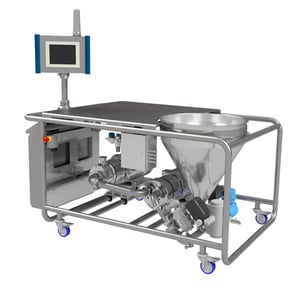
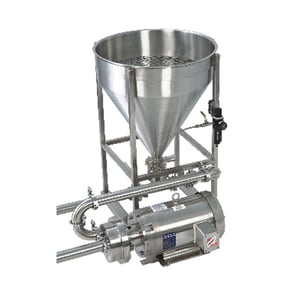
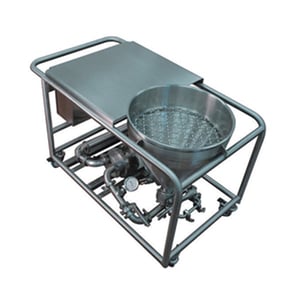
Powder Induction
Hygienic Customers


