


When a cream separates, a gum forms fisheyes, or production cannot reproduce the texture achieved in the lab, it is easy to blame the formulation. But often, the ingredients are not the real problem. The mixing process is.
In personal care and cosmetic manufacturing, the way powders are incorporated, droplets are reduced, viscosity is developed, and air is managed can directly affect product stability, appearance, texture, and performance. Choosing the right industrial mixer—and controlling how it is used—can help manufacturers produce more consistent creams, lotions, serums, gels, and washes while reducing rework and lengthy batch cycles.
The formula may not be the problem. The mixing process may be holding it back.
Why Powder Wet-Out Causes So Many Problems
 Gums, polymers, thickeners, pigments, and powdered actives can be difficult to add to liquids. When powder is dumped too quickly or does not encounter enough liquid and shear, its outer surface may hydrate before the interior becomes wetted. The resulting agglomerates, often called fisheyes, can remain in the product even after extended mixing.
Simply increasing mix time may not solve the problem. It can waste energy, slow production, and introduce more air without fully dispersing the powder.
An effective powder induction and dispersion process brings powders into the liquid under controlled conditions. Proper powder induction can:
- Accelerate the wet-out of gums, polymers, and actives
- Reduce floating powders, fisheyes, and agglomerates
- Minimize dust and improve powder handling
- Shorten processing time
- Create more consistent viscosity development
For formulations that thicken rapidly, the sequence and rate of powder addition are especially important. Efficiently mixing powders into liquids before viscosity becomes too high helps preserve circulation and gives the mixer a better opportunity to create a uniform dispersion.
Better Emulsions Begin with Controlled Shear
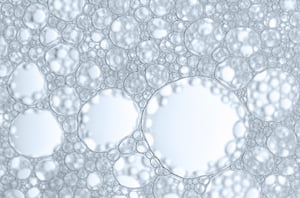 Creams and lotions depend on the successful combination of oil and water phases. Forming an emulsion is only the beginning; the process must also create a controlled droplet-size distribution that supports the desired stability, texture, and appearance.
A high shear mixer applies the mechanical energy needed to break droplets apart and distribute them throughout the continuous phase. When shear and flow are properly matched to the formulation, manufacturers can achieve:
- More uniform emulsions
- Improved product stability
- Consistent texture and appearance
- Better repeatability from batch to batch
More shear, however, is not automatically better. Mixer selection, rotor-stator configuration, processing time, temperature, ingredient order, and batch circulation all influence the final result. The goal is to deliver the appropriate amount of shear throughout the batch—not merely create an intense mixing zone in one location.
Viscosity, Air, and Circulation Are Connected
 As a formulation thickens, its flow behavior changes. A mixer that performed well at the beginning of the batch may struggle to maintain complete circulation later in the process. Poor turnover can leave material at the vessel wall or surface insufficiently mixed, producing inconsistent texture or concentration within the same batch.
Air entrainment adds another challenge. Excess air can affect density, appearance, filling accuracy, stability, and the way a product feels when applied. In some products, entrained air may also make it harder to evaluate whether the target texture has truly been achieved.
Effective process design considers shear, pumping capacity, mixer position, powder-addition method, and batch geometry together. This broader view helps manufacturers develop viscosity without losing circulation or pulling unnecessary air into the product.
Moving from the Lab to Full-Scale Production
A formula that performs perfectly in a beaker does not always behave the same way in a production vessel. Scale-up changes the distance ingredients must travel, the time required for complete batch turnover, and the way energy is distributed through the product.
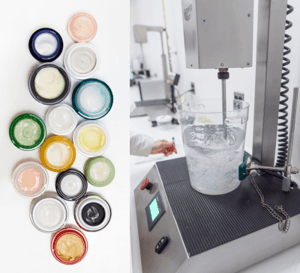 Matching production equipment based only on RPM can therefore be misleading. Reliable scale-up requires evaluating factors such as shear rate, flow, tip speed, power input, batch geometry, ingredient-addition sequence, and processing time.
Testing with representative ingredients and process conditions can reveal whether a high shear mixer, inline mixer, homogenizer, powder mixer, or combination of technologies is the best fit. It also gives manufacturers an opportunity to establish a repeatable process before committing it to production.
Hygienic Design Supports Faster, More Reliable Production
Mixing performance is only part of the equation. Personal care and cosmetic manufacturers also need equipment that supports cleaning, inspection, documentation, and efficient product changeovers.
 Hygienic mixers designed with cleanability in mind can help reduce residue and simplify transitions between products. For facilities guided by hygienic processing principles, 3-A-ready mixer options can also support a more disciplined and repeatable manufacturing environment.
The best solution connects product quality with operational performance. Whether the process requires an in-tank high shear mixer, powder induction system, inline mixer, emulsifier, or wet mill, the equipment should be selected around the behavior of the formulation and the realities of production.
Take Control of the Mixing Step
Persistent clumps, unstable emulsions, unpredictable viscosity, and inconsistent batches do not always require a reformulation. They may indicate that the current process is not providing the right balance of powder induction, flow, shear, and control.
Admix works with personal care and cosmetic manufacturers to evaluate these challenges and identify mixing solutions designed for consistent product quality, efficient processing, and reliable scale-up.
Ready to improve your mixing process? Explore our personal care and cosmetic manufacturing mixing solutions or speak with an Admix mixing specialist.