

Dispersing Powder Into Liquid
In chemical manufacturing, powders into liquids is rarely a simple “add and mix” step. Pigments, fillers, resins, rheology modifiers, and functional additives can float, clump, or form stubborn agglomerates that survive the entire batch—especially when added too quickly or without enough localized energy at the point of addition. The core issue is wet-out: each particle must be fully contacted by liquid and drawn below the surface before it can disperse. If wet-out is incomplete, you’ll see defects such as specks, undispersed solids, inconsistent viscosity, color variation, filter plugging, and extended batch times.
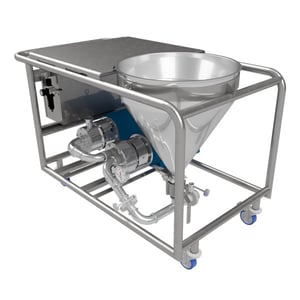
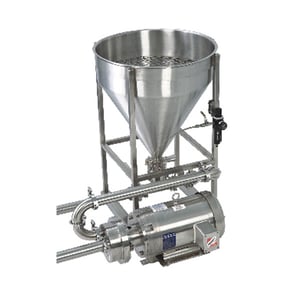
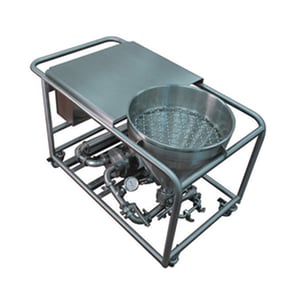
Reliable powders-into-liquids performance typically comes down to addition control and shear exposure. When powders hit the surface in a rush, they can raft and entrain air. When the process doesn’t repeatedly move material through a high-energy zone, partially wetted clumps can harden and become difficult to break down. Many chemical processors improve consistency by controlling how powders enter the liquid (often under the surface or via induction) and pairing that step with high shear mixing to accelerate wet-out and dispersion. For a deeper overview of how high shear mixers support chemical powders-into-liquids processes—including inline vs in-tank selection—visit our high shear mixing page.
Chemical Agglomerates and Fish-Eyes (What They Cause + How to Reduce Them)
In chemical processes, agglomerates and fish-eyes often form when powders partially wet on the outside and trap dry material inside. These “sealed” clumps resist further wetting and can persist even after extended mixing, showing up as visible defects (specks, grit), poor color development, inconsistent rheology, and downstream issues like screening or filtration problems. They’re especially common with hard-to-wet powders such as pigments, fillers, and rheology modifiers—where the first minutes of the addition step can determine whether the batch disperses cleanly or becomes a rework risk.
To reduce agglomerates and fish-eyes in chemical powders-into-liquids mixing, focus on:
- Controlled powder feed rate: avoid dumping powders onto the surface where they raft and encapsulate air.
- Immediate sub-surface wetting: get powders below the surface quickly so liquid contacts each particle.
- Early high shear exposure: apply high shear during the addition step, before clumps stabilize.
- Process sequencing: pre-wet or stage additions to prevent overload conditions that create persistent clumps.
- Turnover and recirculation: ensure all material passes repeatedly through the shear zone (especially in inline loops).
-
All
-
Powder Induction
-
High Shear
Chemical Customers